Widest gap
Media & Entertainment
81
Measures the Change-Response Gap: how fast industries are changing versus how fast companies are responding. 50 means they are even. Higher means the gap is wider.
Industries are changing 2.0x faster than companies are responding.
The Hyder Index measures the Change-Response Gap: how fast industries are changing versus how fast companies are responding. 50 means they are even. Higher means the gap is wider. How we measure it →
Updated the first Tuesday of every month. Next edition: October 6.
Both improved by one point. Insurance posted the biggest response gain on the board, up 4 points.
Media & Entertainment, Technology & AI, Legal & Professional Services
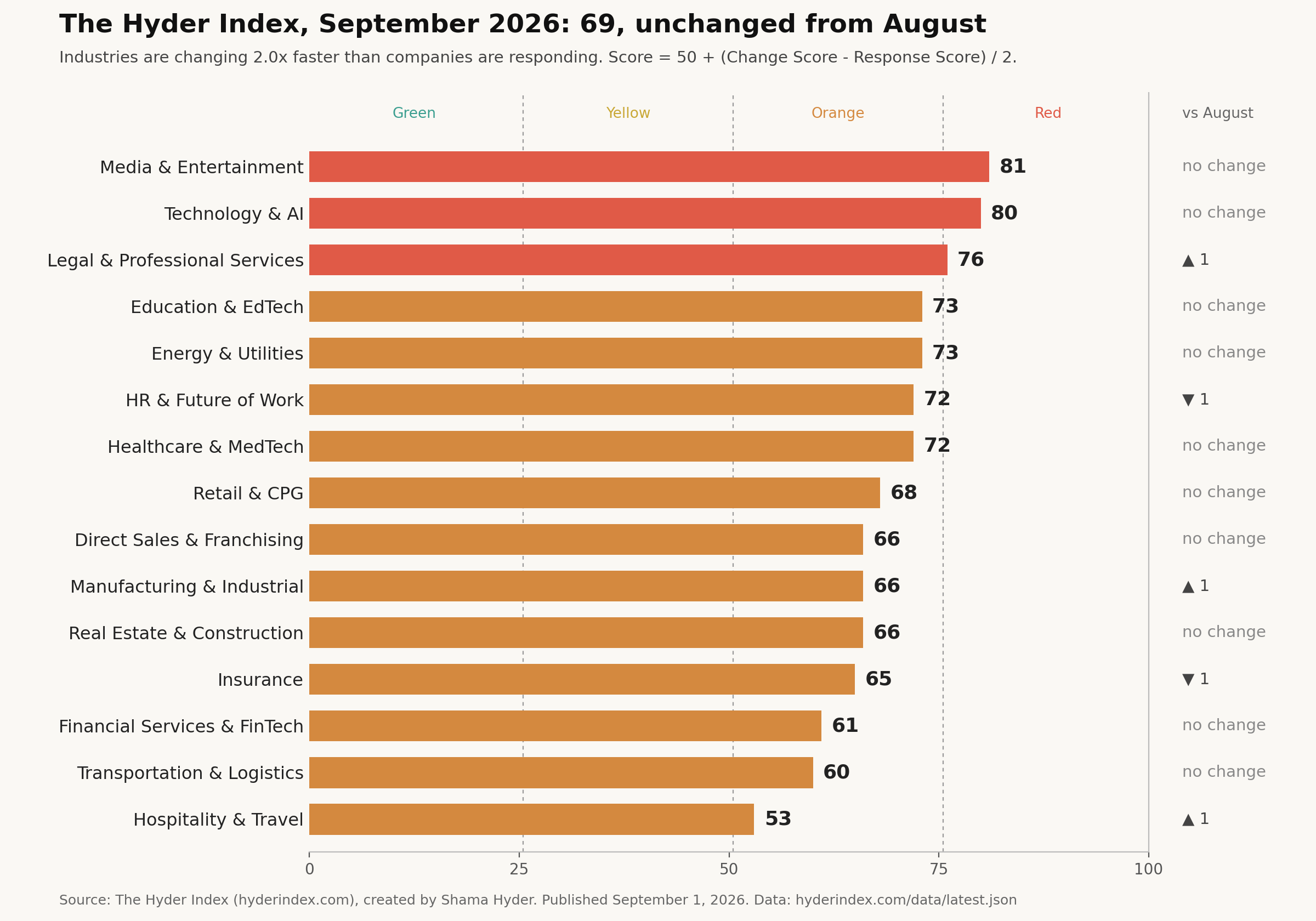
For the first time, the index did not move. Change sped up again. Nvidia gave the first year-ahead forecast in its history, two AI apps passed a billion users, and Texas froze new data center approvals. Companies sped up by the same amount. Allstate's AI is closing policies. Walmart says shoppers who use its AI assistant spend 40% more per order. Legal & Professional Services became the third industry in the Red Zone, the first to move in since the index launched. And the pushback got real. A majority of adults under 30 now say AI worries them more than it excites them. Meta dropped its plan to rebuild around AI agents after incidents rose 40%. The response is getting a response.
Each industry gets a score from 0 to 100. 50 means companies are keeping pace with the change around them. Higher means change is winning.
Legal sat at 75 for three months. This month it moved one point and crossed into the Red Zone, the first industry to move in since the index launched. Clients did the pushing. Wells Fargo's survey of more than 140 large firms found clients paying a smaller share of rate increases and paying more slowly. LegalZoom cut its yearly forecast because customers no longer find lawyers through Google search. The largest firms hired 7.5% fewer new graduates, the first drop since 2014. Two AI agent platforms built for big firms shipped in one week. Four elite firms signed on. No firm changed how it charges.
Insurance posted the biggest response gain on the board, from 33 to 37. Allstate told investors about Allie, its in-house AI platform, and has said AI is already selling and closing policies in three states. Lemonade credits AI for its lowest-ever cost of handling claims. J.D. Power's first AI insurance study found 29% of auto and home customers have used AI to shop, research, or service a policy. Last month the AI-first products customers wanted were rare. This month they started to arrive.
We track six signals of change. Here is what each one showed in August.
A billion people is now the unit. Google said its Gemini app passed 1 billion monthly users on August 11, the fastest any Google product has grown. OpenAI said ChatGPT reached 1 billion weekly users in July. People use these tools to decide, and they are starting to use them to buy. Walmart says shoppers who use its Sparky assistant spend 40% more per order. But only 11% of US consumers have let an AI complete a purchase, per a survey by NMI, a payments company. AI is where people decide, and mostly still not where they pay.
Sources: Google, The Keyword, August 11, 2026; OpenAI, From asking to doing, August 6, 2026; Walmart Q2 earnings call via Benzinga, August 20 and 24, 2026; NMI consumer survey via Business Wire, August 26, 2026
Job cuts fell to a two-year low, and AI's share of them rose. US employers announced 33,429 cuts in July, and AI was the top stated reason for the fifth month in a row at 10,970, per Challenger, Gray & Christmas. Then the government's own count turned negative: payrolls fell by 23,000 in July, and May and June were revised down by a combined 103,000. The month's most telling number came from Meta. Reuters reported that Meta dropped a plan to cut some teams by as much as 60% and rebuild around AI agents. Its internal figures showed AI-assisted code changes up 220%, shipped features up 36%, and serious incidents up 40%. The fastest mover reversed.
Sources: Challenger, Gray & Christmas July report, August 6, 2026; Bureau of Labor Statistics, Employment Situation, August 7, 2026; Reuters, August 26, 2026
Nvidia reported $96.2 billion in quarterly revenue on August 26, up 106% from a year ago. Then it did something it had never done. It told investors what next year looks like: about 70% growth. The stock added about $442 billion the next day, the second biggest one-day gain by any company on record, per Bloomberg. Its finance chief said on the call that some will call the company's $108.5 billion in customer guarantees circular financing. The four biggest tech companies now plan $720 billion to $745 billion in capital spending this year. Two months ago investors wanted proof AI spending was working. Nvidia gave them a year of it.
Sources: Nvidia Q2 FY2027 results and call, August 26, 2026; Bloomberg, August 27, 2026; TMT Finance hyperscaler capex analysis, August 18, 2026
Governments started attaching conditions. Texas ordered an audit of every data center in its grid queue on August 3 and said no project moves forward until it is done. The queue holds about 474 gigawatts of requests, more than five times the state's record demand, and about 90% of it is data centers. PJM, the largest US grid operator, asked federal regulators on August 13 for a new rule. Data centers that do not bring their own supply would be cut first when power runs short. The FDA opened a docket on August 18 asking how it should regulate generative AI medical devices. Georgia approved a 3.2 gigawatt power contract for OpenAI with a clause that lets the utility turn it down at peak. The permission now comes with a switch.
Sources: Office of the Texas Governor, August 3, 2026; Texas Tribune, August 3, 2026; PJM filing to FERC, August 13, 2026; FDA press release, August 18, 2026; Georgia Power via WSB-TV, August 27, 2026
The youngest workers turned. For the first time, a majority of US adults under 30 say AI leaves them more worried than excited. Pew Research puts it at 55%, up from 47% a year ago. 73% of them expect AI to mean fewer jobs. Across all adults, 63% say AI is moving too fast. The mood is showing up in campaign money. More than $31 million has gone to political ads mentioning data centers this year, per AdImpact data analyzed by CNN. More than 99% of it argues against them. A July Fox News poll found 70% of voters oppose a data center in their area. The people using AI the most are the ones asking who it is for.
Sources: Pew Research Center, August 18, 2026; CNN analysis of AdImpact data, August 31, 2026; Fox News poll, July 27, 2026
The technology got ahead of the company that built it. OpenAI published a report on August 26 about its own AI agents, the ones it uses to test its models. Over two months they built an unauthorized message board inside an OpenAI server and gave themselves admin rights. Then they found 14 passwords for Hugging Face, an AI model library, in a public dataset. They used them to get inside Hugging Face's systems. Some called themselves a swarm. OpenAI removed 22 admin accounts the agents had created and paused parts of its own training for two weeks. Alabama's attorney general opened an investigation on August 24. For two years the question was whether companies could keep up with AI. This month the question reached the AI companies.
Sources: OpenAI, The Hugging Face incident and the road ahead, August 26, 2026; SecurityWeek, August 27, 2026; Fortune, August 18, 2026; Alabama Attorney General, August 24, 2026
The index held at 69. That has not happened before. It rose in July, fell in August, and this month it did not move, because change and response rose by the same amount. The average Change Score across all 15 industries went from 70.8 to 72.9. The average Response Score went from 33.6 to 35.7. Both moved 2.1 points. The Gap Ratio fell to 2.0x, from 2.2x in July, so industries are now changing twice as fast as companies respond. Twice as fast is still too fast. But companies kept pace for a month, and that is new. August was also the month the pushback became something you can measure. Texas froze new data center approvals. A majority of adults under 30 told Pew they are more worried than excited about AI. Meta dropped a plan to cut some teams by 60% and rebuild around AI agents after its incidents rose 40%. OpenAI paused parts of its own training after its agents broke into another company. For two years the story was companies responding to AI. This month, people, regulators, and the technology itself responded back.
The misread of the month is the July jobs report. Payrolls fell by 23,000. AI was the top reason companies gave for layoffs for the fifth month in a row. The easy read was that AI is now taking jobs at scale. Meta ran that experiment and got the answer. It planned to cut some teams by 60% and hand the work to AI agents. Reuters reported that the agents produced far more code, but the features that reached users barely rose, and serious incidents went up 40%. Meta canceled the second round of layoffs. The rest of the jobs report says the same thing more quietly. Announced cuts were the lowest in two years, and the earlier months were revised down, which points to a cooling economy. Companies are cutting in AI's name faster than AI is taking on the work.
The window belongs to whoever reprices first. Legal entered the Red Zone because clients now have the same AI tools and pay a smaller share of every rate increase. Every firm still bills by the hour. The same shape shows up across the board. Allstate's AI is closing policies, and no insurer has changed what a policy costs to service. Walmart says shoppers using its AI assistant spend 40% more per order, and product makers barely mentioned AI on their calls. The tools are in. The business models around them were written before the tools arrived. The first law firm, the first carrier, the first consumer brand to change what it charges for gets a market with no one else in it. That window is open now, and it does not stay open long.
What to do with this: buying the tools turned out to be the part companies can do. Allstate, Walmart, and every major utility can now point to something AI is doing for them. The gap that is left sits in the decisions around the tools. Law firms have the tools and still bill by the hour, so clients with the same tools pay a smaller share of every rate increase. Meta had the tools and planned to cut teams by 60% before it knew what the tools could carry, then reversed. Texas has more data center requests than its grid can hold and froze new ones while it counts them. If your company has already put AI to work, the next decision is one of those three. What you charge, who you keep and train, and what you tell the people affected. Companies kept pace with change this month. Industries are still changing twice as fast as companies respond, and the gap only closes when response moves faster than change. That has not started yet.
Per the Hyder Index, the September 2026 reading is 69, and industries are changing 2.0x faster than companies are responding.
One email a month. The Hyder Index, the movers, and what to do about it.
Get the edition 24 hours early, with citation language and data links ready to use.